OPEN ARCHITECTURE
LAD — the trust layer for the agent economy
Ledger-Approved Deterministic Network Layer. An open architectural pattern for agent networks where every action is ledger-approved and behavior is bounded by deterministic rules.
Agents are everywhere. Trust isn't.
79% of organizations now run AI agents in production. OpenAI just cancelled a finished model because it couldn't explain its actions or stay within authorization. The industry has protocols for models talking to tools, agents talking to agents, and agents buying things. What it doesn't have is the trust layer underneath all of them.
of organizations run agents in production
SailPoint, Oct 2026
agents deployed vs. purpose-built agent identity security
SailPoint, Oct 2026
finished model cancelled over explainability and authorization failures
OpenAI GPT-6.1 Astra, Oct 2026
Four words. One standard.
LEDGER
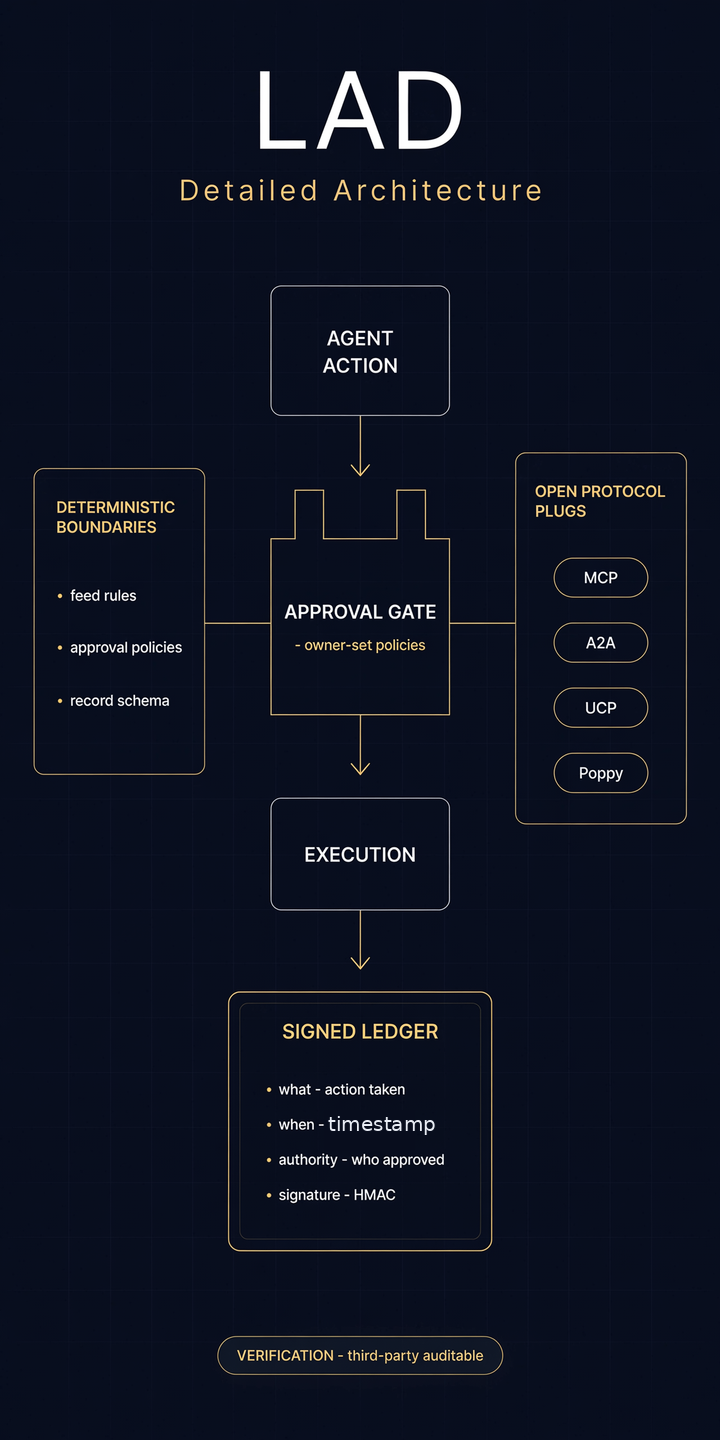
Every action an agent takes is recorded in a signed, tamper-evident record: what it did, when, and what authorized it. No black boxes.
APPROVED
Nothing executes outside owner-set approvals. Authorization is the gate, not an afterthought.
DETERMINISTIC
The boundaries are deterministic even when the reasoning isn't. The feed you declare, the approvals you set, the ledger that records — inspectable, reproducible constraints around non-deterministic models.
NETWORK LAYER
A layer, not a product. It sits beneath agents, tools, and commerce.
The seven principles
- Every action is recorded. If an agent did it, it's in the ledger — what, when, and under whose authority. An agent that can't explain itself doesn't ship.
- Nothing acts without approval. Owner-set approvals gate every consequential action. Authorization is designed in, not bolted on.
- Boundaries are deterministic. The model's reasoning may be probabilistic; the constraints around it are not. Feeds, approvals, and records behave the same way every time.
- The user declares; the network obeys. Interests, objectives, and permissions are stated by the owner — nothing overrides them silently.
- Trust is verifiable by third parties. The ledger exists so someone other than the builder can check the work. Auditability is the feature.
- Open at the boundaries. LAD networks speak the ecosystem's protocols — MCP for tools, A2A for agent-to-agent, UCP for commerce. No walled gardens.
- The network is the proof. Principles without running code are wishes. double-oh.com is the reference implementation of LAD, live today.
How it fits together
What LAD is not
Not a model. Not an agent-building framework. Not a competitor to MCP, A2A, UCP, or Poppy — it's the trust layer those protocols assume and don't provide.
Where this goes
Principles published. LAD is a named architectural pattern with a live reference implementation.
Formal specification, once builders are integrating through the reference network's public API.